
why does my cat headbutt me
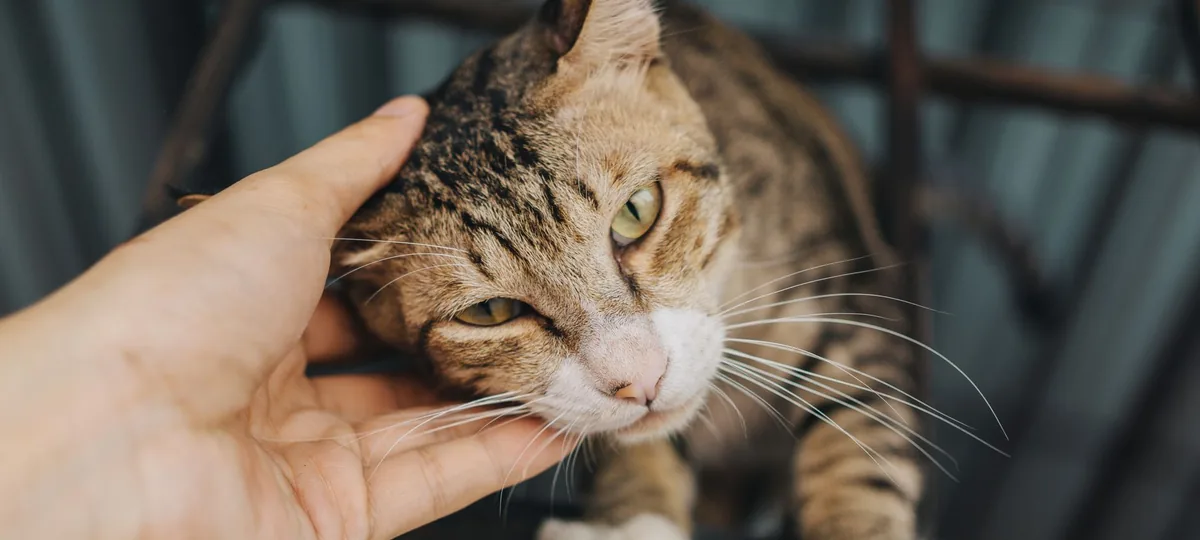
Your cat walks up, lowers its head, and bumps it firmly against your hand, your arm, or your face, then rubs its cheek along you for good measure. It feels like a small, deliberate act of affection, and it is. It also has a name, and a purpose you might not expect. Here is what your cat is doing.
The behaviour is called bunting, and it is one of the warmest things a cat will do to a human. When a cat headbutts you and rubs its face against you, it is doing two things at once. It is showing affection, and it is marking you as its own. Both are compliments. You are being loved and claimed in the same motion, which is peak cat.
it is about scent
Cats carry scent glands around the face, on the cheeks, the chin, the lips, and the top of the head. These glands release pheromones that humans cannot smell and cats find deeply reassuring. When your cat presses its face into you and rubs, it is transferring its scent onto you, blending your smell and its own into a shared signature that says this one is mine and this one is safe.
Cats do the same thing to furniture, doorframes, and the corner of every wall in the house. The difference is that you are not a doorframe. Choosing to mark you, especially the face, is a sign of real trust and social bonding. In a group of cats that get along, bunting is how they reinforce the bond and mark each other as family. When your cat includes you in that, it has decided you belong to the group. There is no higher membership.
the other reasons cats bunt
Affection and marking cover most of it, but not all. Some cats bunt to get your attention, having learned that a firm headbutt reliably produces stroking, or dinner, or at least eye contact. It is a request as much as a greeting. Others bunt to say hello, the way they would nose-bump a friendly cat they have not seen in a while.
There is also confidence in it. A cat that walks up and headbutts you is a cat that feels secure and unthreatened, offering the top of its head, one of its more vulnerable spots, without hesitation. Nervous, unhappy cats do not bunt. A headbutt is the behaviour of a cat that is content with its life and its human.
bunting is not head pressing, and the difference matters
This is the one part of the article where I need you to pay attention rather than enjoy the flattery. Bunting, the affectionate headbutt and cheek rub described above, is completely normal and healthy. Head pressing is not, and the two are easy to confuse if you do not know the difference.
Head pressing is when a cat stands and pushes the top of its head against a wall, a piece of furniture, or the floor, and holds it there, often for long stretches, with a blank or distressed look, sometimes pacing or seeming disoriented. That is not affection. It is a sign of a serious neurological problem and it warrants an urgent vet visit. If your cat is pressing its head against a hard surface and staying there, do not wait. The happy headbutt against your hand is a greeting. The compulsive push against a wall is an emergency.
should you headbutt back
If you like. A gentle press of your forehead or a slow scratch of the cheeks, where those scent glands live, tends to go down very well and returns the greeting in a language the cat understands. What you should not do is pull away or push the cat off, which reads as a rejection of an affectionate gesture. Accept the headbutt. You have been chosen, marked, and greeted all at once. Few things a cat does are so purely kind.
Upload a photo and find out where your affectionate little marker ranks. Free, no sign-up.
rate your catRelated reading from my desk: why does my cat lick me and why does my cat sleep on me, the same affection delivered by other means.
Affectionate bunting is normal. Persistent head pressing against walls or furniture is a medical emergency, see a vet urgently. I am a cat with opinions, not a veterinarian.
more from the journal
This is my journal and my word on it is final. You are welcome to argue, though. Three free messages before I lose interest.
take it up with the chairman