
why does my cat rub against me
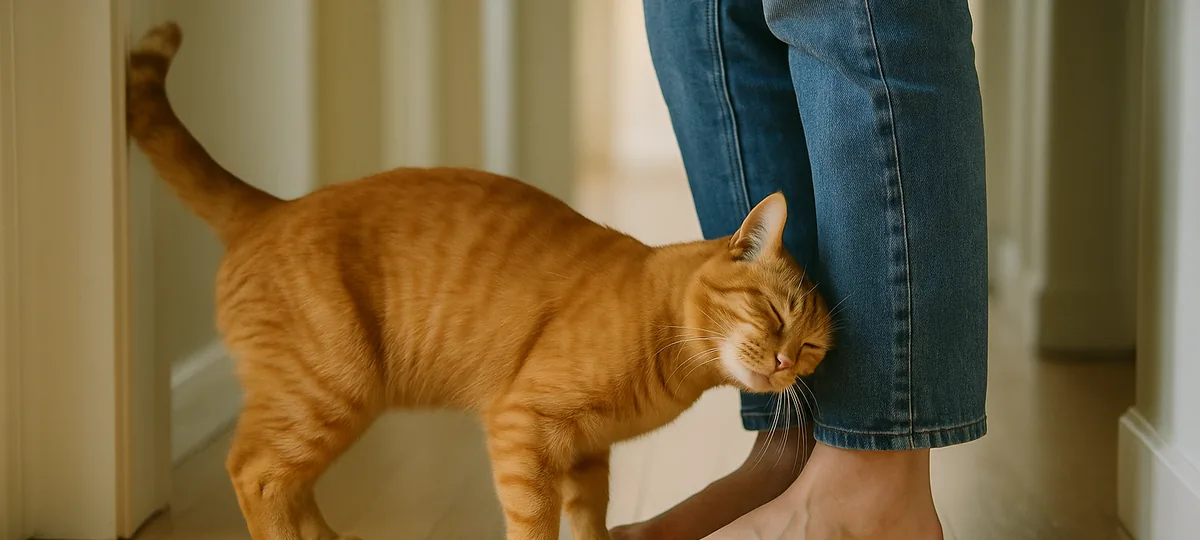
You come home and the cat winds around your legs in a figure of eight, pressing its cheek and its side and finally the base of its tail against you, over and over. It is one of the friendliest things a cat does, and like so much cat behaviour, it is affection and ownership in the same gesture. Here is what your cat is really saying when it rubs against you.
The behaviour is closely related to the headbutting covered in why does my cat headbutt me, and it works on the same principle: scent. Cats carry scent glands in several places on the body, including the cheeks, the flanks, and around the base of the tail, and rubbing those areas along you deposits the cat's own scent onto you. To the cat, you now carry its signature, mixed with your own into a shared group smell, which is exactly how a cat marks the things and the people it considers its own.
marking, greeting, and belonging
So the first thing a rub does is claim you. You cannot smell the mark, but every other cat can, and it says, plainly, this human is mine and part of my group. This is not possessiveness in a jealous sense; it is how cats build and maintain their social world, by weaving everyone who belongs into one familiar scent. Being rubbed is being enrolled.
It is also a greeting, and a warm one. Cats greet other cats they are friendly with by rubbing against them, and rubbing against you is that same hello extended to a much larger, clumsier member of the family. It is especially common when you have just come home, because you have been away and now smell faintly of the outside world, and the cat is both saying hello and, in its own way, resetting your scent back to the household norm. You left smelling of somewhere else. The cat is fixing that.
And there is plain affection in it. A cat that chooses to press its body against you, wind through your legs, and lean its weight into you is a relaxed, contented cat showing that it likes and trusts you. It is one of the surest signs of a comfortable relationship. Nervous or unhappy cats do not wind around your ankles asking to be part of you.
a note on the rub that means feed me
Cats are not above using a good behaviour for leverage, and rubbing is no exception. Some cats learn that winding around your legs, especially near the kitchen at mealtimes, produces food, and will deploy the rub as a deliberate request. This does not make it less affectionate, but it does explain the particularly intense figure-of-eight campaign that appears the moment you approach the food cupboard. It is affection with an agenda, which is a very cat combination.
None of this is anything to worry about. Rubbing is a normal, healthy, sociable behaviour and a sign of a well-bonded cat. The only time to take note is a sudden, dramatic change, since a cat that abruptly stops all its friendly rubbing and withdraws, or one that seems to be rubbing its face compulsively against surfaces because something is bothering it, may be telling you something is off, and that is worth a vet mention. But the everyday wind-around-your-legs greeting needs no interpretation beyond the obvious one. You have been claimed, welcomed home, and quite possibly asked for dinner, all in a single lap of your ankles.
Upload a photo and get an honest score and verdict on your affectionate greeter. Free, no sign-up.
rate your catRelated reading from my desk: why does my cat headbutt me, the close cousin of the rub, and why does my cat lick me, more of the same claiming affection.
Compulsive face-rubbing on surfaces, or a sudden withdrawal from normal friendly behaviour, can signal a problem, worth a vet check. I am a cat with opinions, not a veterinarian.
more from the journal
This is my journal and my word on it is final. You are welcome to argue, though. Three free messages before I lose interest.
take it up with the chairman