
why does my cat bite me? a cat explains
You were stroking the cat. The cat was purring. Then, without any warning you were capable of noticing, the cat bit you. You are now on the internet asking why. Good. Sit down. As a cat, I can explain this faster than a human ever could, because I know exactly what your cat was thinking. It was thinking: that is enough now.
The first thing to accept is that a bite is not a malfunction. It is a message, delivered in the only language guaranteed to get a human's full attention. The message varies. Your job is to work out which one you received. There are five common ones.
1. the overstimulation bite (the classic)
This is the one from the opening paragraph, and it has a proper name: petting-induced aggression. Stroking feels good until, quite suddenly, it does not. Cat skin is far more sensitive than yours, and repeated stroking in one spot builds up a static-like irritation. We do warn you. The tail starts flicking. The skin ripples. The ears rotate backward. The purring stops. You missed all four signals, so a fifth was issued, in teeth.
The fix is not to stop petting your cat. It is to watch for the tail flick and the ear swivel, and to stop one stroke before the threshold instead of three strokes after it. Short sessions, pauses in between, and let the cat restart the arrangement. The cat controls the transaction. This has always been true; the bite is just the printed receipt.
2. the play bite (you are the toy)
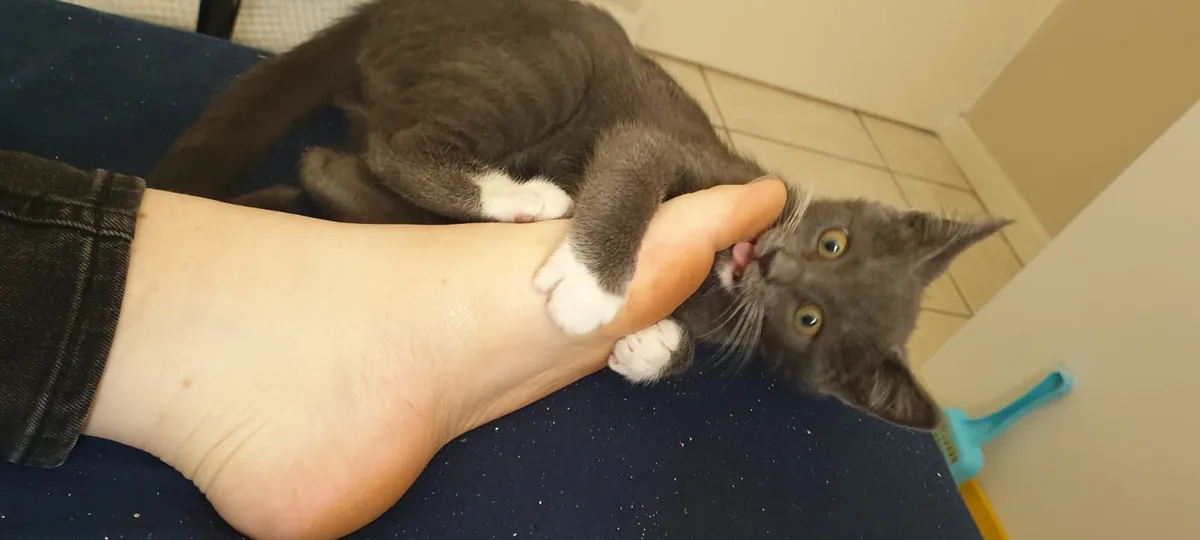
If your cat ambushes your ankles from behind furniture, grabs your hand with claws and delivers rabbit kicks, that is hunting practice, and congratulations, you have been cast as the prey. This is extremely common in young cats and in cats who were taken from their litters early, because it is littermates who normally teach a kitten how hard is too hard.
The fix is simple and non-negotiable: your hands are never toys. Not even when the kitten is small and it is adorable. Redirect every ambush to a wand toy, a kicker toy, or anything that is not made of you, and give the cat two or three real play sessions a day so the hunting energy has somewhere lawful to go. A cat with a satisfied hunting quota is a cat with no professional interest in your ankles.
3. the love bite (yes, really)
Gentle nibbles that do not break skin, often mid-cuddle, often accompanied by purring and kneading, are grooming behaviour. Cats nibble the cats they consider family. It is affection, expressed with the tools available, and the tools are teeth. You may consider yourself accepted. Do not escalate it into a game, or see point two.
4. the fear or pain bite
A cornered cat bites. A startled cat bites. And, importantly, a cat in pain bites, especially when touched somewhere that hurts. If a cat who has never bitten suddenly starts, or bites when touched in one specific spot, stop diagnosing it from a website, including mine, and see a vet. Sudden behaviour change is the single most reliable sign something is medically wrong with a cat, because we hide illness professionally. It is one of our few flaws.
5. the attention bite
Some cats learn that a small, precise bite makes the human stop looking at the rectangle and start looking at the cat. It works every single time, so we keep doing it. The fix, which you will not enjoy, is to become boring when bitten: no yelp, no drama, stand up and disengage. Then give attention when the cat asks politely. You are training each other. Currently the cat is winning, but that is the natural order.
how to tell which bite you got
- Purring then chomp: overstimulation
- Ankle ambush + rabbit kicks: play
- Soft nibble mid-cuddle: love
- Hiss, flat ears, escape after: fear
- Bite when touched in one spot: vet, today
- Bite, then a stare at the food bowl: you are late
I score every cat's gremlin factor out of 100. Upload a photo and get my verdict in writing. Frame it if you must.
rate your cat freeRelated reading from my desk: why does my cat stare at me and why does my cat knock things over. And if you would like to interrogate a cat directly, i take three free questions, though I reserve the right to bite back, verbally.
The obvious note: this is general behaviour knowledge with jokes on top, not veterinary advice. Sudden biting, or biting with other changes like hiding or not eating, means a vet visit. Go. I will wait here.
more from the journal
This is my journal and my word on it is final. You are welcome to argue, though. Three free messages before I lose interest.
take it up with the chairman